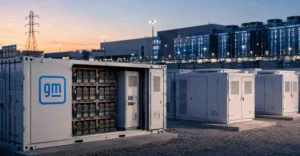
The growing demand for electricity from AI-powered infrastructure is pushing companies from different industries into the energy storage market. As data center operators search for reliable ways to secure power and manage growing energy needs, automotive manufacturers are increasingly exploring opportunities beyond electric vehicles. General Motors has now become the latest automaker to enter this space with a broad energy storage strategy aimed at supporting both grid-scale deployments and data center operations.
The company announced new initiatives that expand its role in the energy storage sector, including the development of sodium-ion batteries, partnerships with energy storage companies, and additional projects focused on repurposing EV batteries. The move places GM among a growing group of automotive companies seeking to address rising power demands linked to AI infrastructure and large-scale industrial operations.
GM partners with Peak Energy on sodium-ion batteries
A key part of GM’s latest energy storage push is its partnership with Peak Energy, an energy storage startup focused on grid-scale battery systems. Through the collaboration, GM is developing a new sodium-ion battery chemistry specifically designed for energy storage system deployments.
The announcement is notable because automakers outside China have not previously revealed plans to manufacture sodium-ion battery cells. While lithium-ion batteries remain the dominant technology for electric vehicles and energy storage applications, sodium-ion batteries are attracting attention because of their potential cost and safety advantages.
According to GM executives, sodium-ion batteries offer characteristics that align well with grid-scale storage requirements. These batteries can be cheaper to produce, provide long operational lifespans, and present a lower risk of overheating compared with traditional lithium-ion alternatives.
The trade-off, however, is lower energy density. Sodium-ion batteries require more space and weight to store the same amount of electricity. For stationary applications such as utility-scale projects and data center support systems, that limitation is often less significant than it would be in vehicles.
Energy storage systems designed with fewer components
Peak Energy has already been developing energy storage systems that use sodium-ion technology. Because sodium-ion batteries operate differently from lithium-ion batteries, the company has designed systems that eliminate some components commonly found in conventional battery installations.
Its battery systems do not require cooling systems or fire-suppression systems due to the lower overheating risk associated with sodium-ion chemistry. Company executives believe removing these components can lower initial deployment costs while also reducing long-term maintenance requirements.
GM plans to supply sodium-ion battery cells that Peak Energy will eventually integrate into its energy storage products. Commercial deployment, however, remains several years away.
The first trial production of GM’s sodium-ion cells is expected to begin in 2028 at the company’s Battery Cell Development Center. GM believes the facility will help accelerate battery commercialization timelines while reducing development costs.
Interim strategy relies on LFP battery technology
While sodium-ion battery production is still under development, GM is pursuing a parallel strategy through lithium iron phosphate (LFP) batteries.
The company said it will provide LFP battery cells to LG Energy Solution for use in energy storage systems. GM and LG Energy Solution already work together through their Ultium joint venture, which produces batteries for GM’s electric vehicle lineup.
This approach allows GM to participate in the energy storage market while continuing research and development efforts around sodium-ion technology.
The combination of near-term LFP deployments and longer-term sodium-ion development reflects GM’s broader effort to establish a presence across multiple segments of the energy storage industry.
Expanding battery reuse projects with Redwood Materials
Alongside its new battery development plans, GM is also strengthening its relationship with Redwood Materials, a company focused on battery recycling and energy storage solutions.
Redwood already purchases battery manufacturing scrap from GM facilities and receives used battery packs from the automaker’s electric vehicles. GM currently has a pipeline of approximately 10,000 battery packs being supplied to Redwood.
One of Redwood’s most prominent projects involves a 12-megawatt, 63-megawatt-hour microgrid operating at a data center in Sparks, Nevada. The system uses second-life EV battery packs to provide energy storage support.
GM also announced that it is purchasing a 7.2-megawatt-hour Redwood energy storage system for use at one of its manufacturing plants in Michigan. The company estimates the installation could generate approximately $3 million in savings over its operational lifetime.
Why data center demand is driving energy storage investment
The increasing focus on the data center sector is a major factor behind many recent energy storage investments. AI workloads require large numbers of power-hungry processors, creating significant electricity demands that can strain existing infrastructure.
Battery storage systems can help data center operators manage power fluctuations, improve reliability, and support continuous operations. According to industry participants involved in these projects, data centers often use batteries much more frequently than traditional industrial facilities.
In a data center environment, battery systems may operate almost continuously to smooth power fluctuations associated with intensive computing workloads. Industrial sites, by contrast, are more likely to use battery storage to reduce peak electricity demand charges and provide backup power during outages.
These differing requirements are creating new opportunities for energy storage providers and battery manufacturers.
GM sees broader deployment opportunities
GM indicated that the Michigan project could represent the beginning of a larger rollout strategy. The company believes battery storage installations can improve operational reliability while delivering economic benefits for manufacturing facilities.
Executives suggested that similar systems could eventually be deployed across additional GM factories if the economic and operational advantages continue to prove successful.
The company’s latest announcements highlight how the growing energy demands of AI infrastructure and the broader data center market are influencing investment decisions far beyond the technology sector. By combining battery development, strategic partnerships, and second-life battery projects, GM is positioning itself to participate in an expanding market that extends well beyond automotive manufacturing.
As the demand for reliable power continues to rise, energy storage solutions are becoming increasingly important for both data center operators and industrial users. GM’s latest initiatives signal that automakers are preparing to play a larger role in meeting those energy needs in the years ahead.
Read More: GM joins Data Center Energy Race With New Sodium-ion Battery Strategy
FAQs
Why is GM entering the data center energy market?
GM sees growing demand for energy storage systems driven by AI infrastructure, data centers, and grid modernization projects.
What battery technology is GM developing?
GM is developing a new sodium-ion battery chemistry through its partnership with Peak Energy.
When will GM’s sodium-ion batteries enter production?
The company expects trial production of sodium-ion cells to begin in 2028.
How are data centers using battery storage?
Data centers use batteries to improve reliability and help manage power fluctuations created by intensive computing workloads.
What role does Redwood Materials play in GM’s strategy?
Redwood Materials works with GM on battery recycling, second-life battery deployments, and energy storage projects for industrial facilities and data centers.