
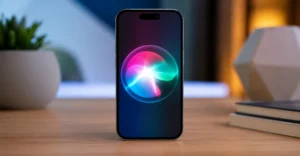
Apple Siri AI: For several years, Apple has faced criticism from industry observers who believed the company was moving too slowly in artificial intelligence compared to rivals investing heavily in the technology. Questions have regularly surfaced about whether the company’s cautious approach could eventually impact product demand, particularly iPhone sales. Now, Apple has responded with what it describes as its most significant AI initiative yet: a major Siri upgrade that introduces advanced automation capabilities, contextual understanding, and integration with Google Gemini. While it remains uncertain whether the announcement will change perceptions about Apple’s position in the AI race, the company appears focused on a different objective—creating AI features that customers will actually use in their daily lives.
Apple focuses on practical AI experiences
During the announcement, Apple emphasized a philosophy that prioritizes usefulness over simply adding AI for the sake of technology trends. The company highlighted its long-standing goal of transforming advanced technologies into intuitive products that can serve a broad range of users.
This message appears to address growing concerns among consumers regarding artificial intelligence. While AI adoption continues to expand, public attitudes remain mixed. Many people are concerned about issues such as job displacement, misinformation, and the broader societal impact of rapidly advancing AI systems.
By positioning its new Siri AI as a practical assistant designed to help users rather than overwhelm them, Apple is attempting to differentiate itself from competitors that have focused primarily on rapid AI deployment.
What new capabilities does Siri AI bring?
The upgraded Siri introduces several notable features designed to improve productivity and convenience.
One of the most significant enhancements is Siri’s ability to retrieve information from various personal data sources, including emails, messages, and other content stored within the Apple ecosystem. Instead of requiring users to manually search through conversations or inboxes, Siri can locate relevant information and present it when needed.
Another addition is onscreen awareness. This feature enables Siri to understand what users are currently viewing on their devices and provide contextual assistance based on that content. The goal is to make interactions feel more natural and relevant.
Apple has also integrated Google Gemini into Siri. Through this partnership, Siri can access current web information and provide near real-time responses when users need updated knowledge beyond what is available on their devices.
The assistant is designed to function across multiple Apple products, creating a more connected experience for users who regularly switch between devices. Similar to other AI-powered assistants, Siri can also retain conversation histories, allowing users to revisit previous interactions.
A strategic advantage within Apple’s ecosystem
The introduction of Apple Siri AI could have implications beyond consumer convenience.
Because Siri operates at the operating system level, Apple has the ability to integrate AI capabilities directly into the core user experience. This may provide advantages compared with third-party AI applications that rely on distribution through the App Store.
For competing AI services, operating system integration represents a significant challenge. Users may find built-in AI tools more accessible than separate applications, potentially reducing the need to download alternative solutions.
However, the real impact of this advantage remains uncertain. Apple has stated that the new Siri experience will initially be released as a beta later this year, meaning widespread adoption and user feedback are still ahead.
Will users actually embrace the new Siri?
Perhaps the most important question is not whether Apple has caught up in the AI race, but whether customers will regularly use these new capabilities.
Technology history has shown that successful products are not always those with the most advanced features. Instead, widespread adoption often depends on simplicity, reliability, and seamless integration into everyday routines.
Apple appears to be betting that its large installed user base will appreciate AI features that require little effort to learn while delivering immediate value.
If users find Siri genuinely helpful in managing emails, retrieving information, understanding on-screen content, and accessing web knowledge, the company could strengthen engagement across its devices without dramatically changing how customers interact with technology.
Apple’s measured AI strategy stands out
The Siri AI launch also highlights a broader difference between Apple and many of its competitors.
While numerous technology companies have invested heavily in AI infrastructure and development, Apple has generally taken a more measured approach. Rather than pursuing aggressive AI expansion at any cost, the company has focused on maintaining strong hardware sales and integrating technology into its existing ecosystem.
This strategy has allowed Apple to continue generating substantial revenue while avoiding some of the massive spending commitments seen elsewhere in the technology sector.
At the same time, Apple has benefited from the growth of AI applications available through its App Store, creating additional revenue opportunities as developers bring AI-powered services to iPhone users.
Read More: Apple WWDC 2026: Siri AI Overhaul and Apple Intelligence Upgrades expected to lead
Conclusion
The launch of Apple Siri AI represents an important moment in Apple’s artificial intelligence journey. Rather than positioning itself as the loudest participant in the AI race, the company is emphasizing usability, convenience, and ecosystem integration. The enhanced Siri combines personal context awareness, inbox intelligence, onscreen understanding, and Google Gemini-powered web access into a single experience designed for everyday use.
Whether this approach will be viewed as a victory in the broader AI competition remains unclear. What is becoming increasingly apparent, however, is that Apple is pursuing a strategy centered on practical value rather than AI hype. If users embrace these new features, the company may demonstrate that success in artificial intelligence is measured not only by technological breakthroughs but also by how effectively those innovations improve daily life.
FAQs
What is Apple Siri AI?
Apple Siri AI is Apple’s upgraded virtual assistant that includes contextual awareness, inbox intelligence, onscreen understanding, and Google Gemini-powered web information access.
Does Siri AI use Google Gemini?
Yes. Apple has integrated Google Gemini to help Siri access up-to-date information from the web when needed.
What is onscreen awareness in Siri?
Onscreen awareness allows Siri to understand what users are viewing on their device and provide relevant assistance based on that content.
Will Siri AI work across Apple devices?
Yes. Apple says Siri AI is designed to operate seamlessly across multiple Apple devices within its ecosystem.
When will the new Siri AI be available?
Apple indicated that the new Siri experience will be released as a beta later this year.