Uber has announced plans to bring its premium robotaxi service to Houston by the middle of 2027, expanding its autonomous ride-hailing program beyond its initial rollout markets. The move marks the second U.S. city selected under Uber’s partnership with electric vehicle manufacturer Lucid and autonomous driving technology company Nuro. The announcement comes as the three companies continue preparations for a robotaxi launch in the San Francisco Bay Area later this year. Uber says the long-term goal is to expand the program into dozens of cities, positioning autonomous transportation as a larger part of its future mobility strategy while increasing competition in the growing robotaxi sector.
Houston becomes the next destination for Uber robotaxi service
Houston is set to become a key market in Uber’s autonomous vehicle plans. The city will follow San Francisco, where preparations are already underway for public deployment of robotaxi services.
The expansion means Uber will compete directly with Waymo, which already operates commercial robotaxi services in both San Francisco and Houston. As competition in autonomous transportation intensifies, Uber is accelerating efforts to establish a presence in markets where self-driving ride-hailing services are already gaining visibility.
The company has indicated that Houston is only the next step in a broader strategy that could see the robotaxi platform deployed across multiple cities over the coming years.
Testing activities continue ahead of public launch
Nuro has been testing Lucid Gravity sport utility vehicles equipped with its autonomous driving technology in San Francisco for several months. Progress has included allowing Uber employees to request rides in the vehicles as part of internal testing programs.
Despite those advances, the vehicles are not yet operating without human supervision. Although Nuro recently obtained regulatory approval that would permit removal of safety drivers from vehicles in California, the current testing phase still includes human operators behind the wheel.
Houston is also playing an important role in development efforts. Uber and Nuro are jointly operating a fleet of approximately 100 autonomous vehicles on public roads in the city with safety operators present. The companies are additionally relying on controlled testing environments and simulation systems to validate performance before making the service available to passengers.
As production ramps up, the testing fleet is expected to grow further. Lucid is preparing to manufacture the first production-ready robotaxis at its facility in Arizona, supporting future deployment plans.
Lucid Gravity serves as the foundation of the robotaxi fleet
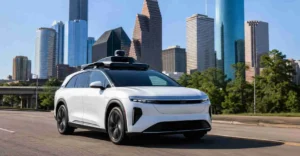
The autonomous service will rely on specially equipped Lucid Gravity vehicles. Introduced earlier this year, the vehicle has been designed to support advanced autonomous operations through a combination of high-resolution cameras, lidar sensors and radar systems.
These technologies allow the self-driving platform to observe and interpret surrounding traffic conditions, road layouts and environmental factors.
While Nuro is responsible for the autonomous driving system, Uber has concentrated on the passenger experience. The company is developing the in-vehicle interface and rider interactions that customers will use when requesting and completing autonomous trips.
The collaboration combines expertise from three different areas: ride-hailing operations, electric vehicle manufacturing and autonomous driving technology.
Uber expands Houston infrastructure ahead of deployment
To support the future launch, Uber is increasing its operational footprint in Houston. The company has established a 50,000-square-foot depot in the city along with a dedicated charging facility that will function as the primary operations hub for the robotaxi fleet.
The infrastructure investment highlights the logistical requirements involved in running a large-scale autonomous vehicle network. Charging, maintenance and fleet management are expected to play critical roles as Uber prepares for commercial operations.
The facility is intended to support daily vehicle operations and help ensure readiness when public service begins.
Partnership provides momentum for Lucid and Nuro
The robotaxi initiative has become an important opportunity for both Lucid and Nuro.
For Nuro, the partnership follows a significant strategic shift made in 2024. The company moved away from developing its own delivery robots and instead focused on licensing autonomous driving technology to automotive manufacturers and strategic partners.
Lucid also stands to benefit from the agreement. Like many electric vehicle startups, the company has faced challenges in scaling vehicle sales in a market where Tesla remains a dominant force. The robotaxi partnership provides a large potential customer for its vehicles and could help increase production volumes over time.
Uber has strengthened the relationship through financial commitments to both companies. The ride-hailing platform has invested in Nuro and has also committed substantial funding to Lucid while agreeing to purchase at least 35,000 robotaxi-ready vehicles for the program.
Read More: Uber Confirms Houston Robotaxi Launch Plans for 2027 With Lucid and Nuro
FAQs:
When will Uber launch robotaxi service in Houston?
Uber plans to launch its premium robotaxi service in Houston by mid-2027.
Which companies are involved in the robotaxi project?
The initiative involves Uber, Lucid and Nuro.
What vehicle will be used for the service?
The fleet will use autonomous-ready Lucid Gravity SUVs.
Is the robotaxi service already driverless?
No. Current testing operations still include safety operators behind the wheel.
What is Uber’s long-term robotaxi strategy?
Uber aims to expand the robotaxi program to dozens of cities in the future.